
CPVC (Chlorinated Polyvinyl Chloride)
When standard PVC reaches its temperature limit, CPVC takes over. Rated for continuous service up to 93°C with excellent chemical resistance — CPVC is the cost-effective solution for hot chemical piping, semiconductor process lines, and elevated temperature industrial applications. Available in sheet and rod form. Ready stock in Johor, Malaysia with nationwide delivery.
Lim
5/19/20264 min read


Overview
Chlorinated Polyvinyl Chloride, universally known as CPVC, is an advanced engineering thermoplastic derived from standard PVC through a post-chlorination process that significantly elevates its heat resistance, chemical resistance, and mechanical performance beyond what standard PVC can achieve. By increasing the chlorine content from approximately 57% in standard PVC to 63–69% in CPVC, the chlorination process fundamentally transforms the material's thermal and chemical performance — extending its continuous service temperature from PVC's 60°C ceiling to a robust 93°C, while simultaneously broadening its chemical resistance profile against a wider range of aggressive substances.
CPVC bridges a critical performance gap in the engineering plastics hierarchy — sitting between the cost-effective but temperature-limited standard PVC and the significantly more expensive fluoropolymers like PVDF and PTFE. For applications requiring reliable performance in hot chemical environments above PVC's temperature limit but where the cost premium of fluoropolymers is difficult to justify, CPVC represents the most practical and cost-effective engineering solution available.
In Malaysia's chemical processing, semiconductor, and industrial piping sectors, CPVC is increasingly specified for hot chemical lines, elevated temperature process piping, and chemical handling systems where standard PVC falls short but the performance demands do not yet warrant the significant cost premium of PVDF or PTFE. With Johor's expanding semiconductor and chemical industries driving growing demand for reliable hot chemical handling materials, CPVC occupies an important and cost-effective position in the material selection hierarchy.
Available Grades
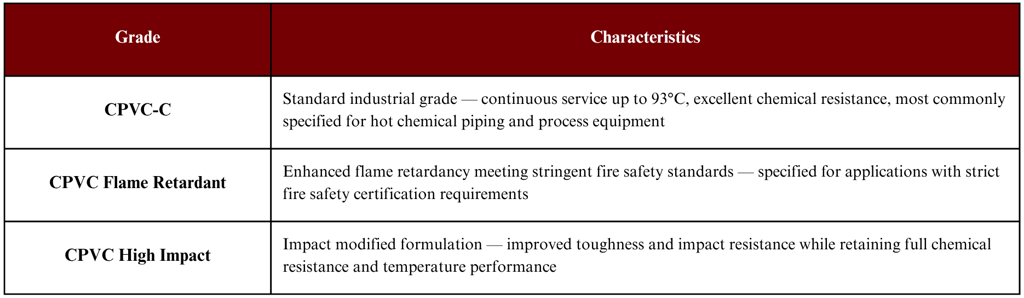
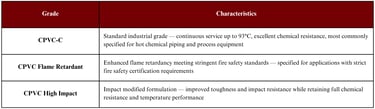
For the vast majority of hot chemical handling and elevated temperature process piping applications, Standard CPVC-C is the appropriate and most cost-effective specification.
Key Properties
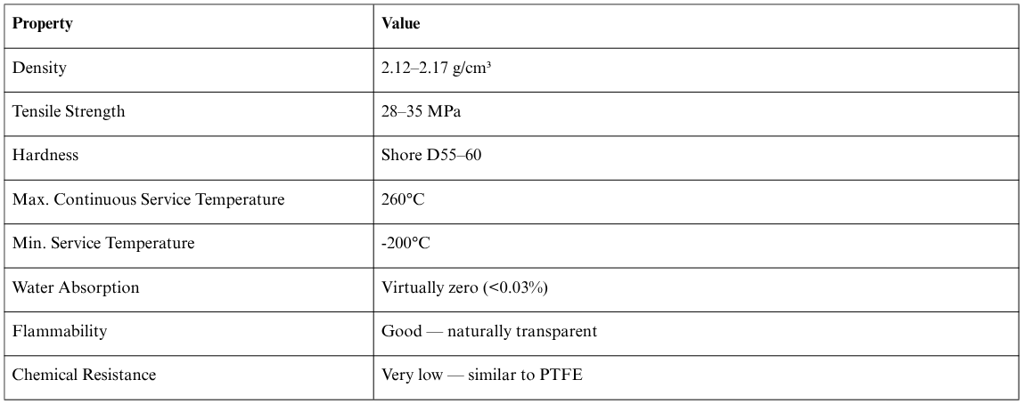
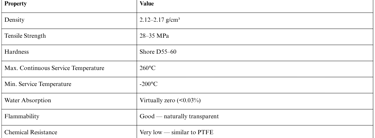
Temperature Resistance
CPVC's most significant advantage over standard PVC is its substantially elevated heat resistance — extending reliable service into temperature ranges where PVC becomes unreliable and begins to deform.
Continuous service temperature: Up to 93°C — a significant 33°C improvement over standard PVC's 60°C limit
Short term peak temperature: Up to 100°C for brief periods
Low temperature performance: Like standard PVC, CPVC becomes increasingly brittle below 0°C — not recommended for cold storage or cryogenic applications
Not recommended for: Continuous temperatures above 93°C — consider PVDF for chemical handling up to 150°C or PTFE/PFA for the most extreme temperature requirements
Important note: CPVC's 93°C rating makes it the natural and cost-effective upgrade from standard PVC for hot chemical lines, heated process piping, and elevated temperature chemical handling — covering the vast majority of industrial hot chemical applications at a fraction of the cost of fluoropolymers
Chemical Resistance
CPVC offers broader and more robust chemical resistance than standard PVC — particularly at elevated temperatures where PVC's performance deteriorates significantly.
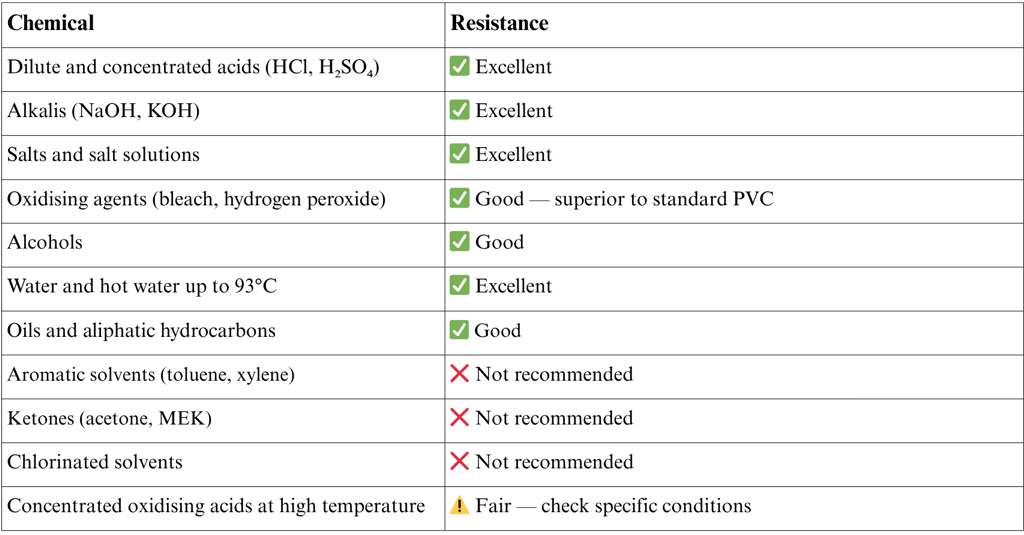
For applications involving aromatic or chlorinated solvents, PVDF or PTFE are the appropriate alternatives. CPVC's chemical resistance at elevated temperatures significantly outperforms standard PVC — making it the reliable choice for hot acid and alkali handling where PVC's performance cannot be trusted.
How CPVC Compares to Similar Materials
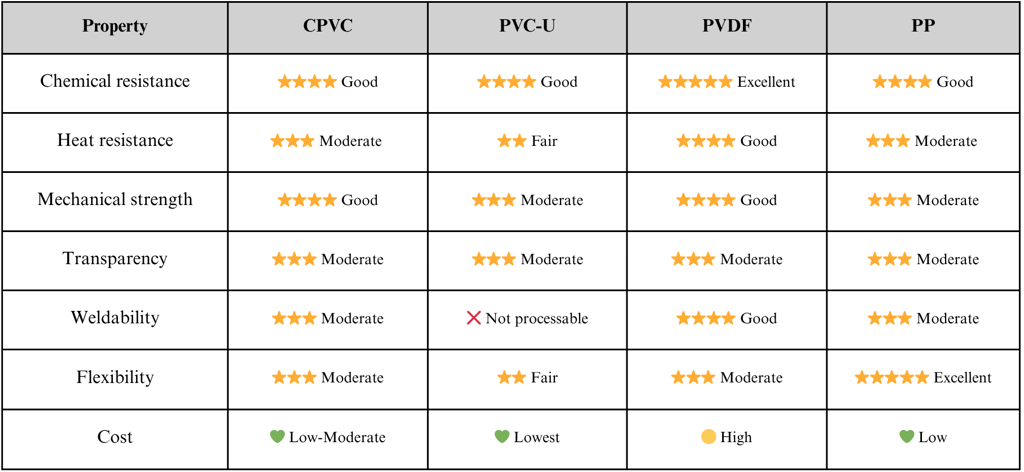
CPVC vs PVC — CPVC is the direct and most practical upgrade from standard PVC for any application where temperature exceeds 60°C. The cost difference between PVC and CPVC is modest, making CPVC the obvious and cost-effective choice for hot water lines, heated chemical piping, and elevated temperature process systems where standard PVC would deform or fail prematurely.
CPVC vs PP — Both handle similar temperature ranges and offer good chemical resistance at accessible price points. PP has better resistance to strong alkalis and is easier to hot air weld into complex fabricated structures. CPVC has superior flame retardancy and better mechanical strength. For fabricated chemical tanks and ducting, PP is generally preferred. For rigid piping systems and structural chemical handling components requiring flame retardancy, CPVC is the stronger choice.
CPVC vs PVDF — PVDF offers significantly broader chemical resistance, higher temperature performance up to 150°C, and superior dimensional stability — but at a substantially higher cost. CPVC covers the majority of hot chemical handling requirements up to 93°C at a fraction of the cost of PVDF. For applications between 93°C and 150°C, or involving highly aggressive chemicals that exceed CPVC's resistance, PVDF is the necessary upgrade.
Common Applications
CPVC's combination of elevated heat resistance, broad chemical resistance, inherent flame retardancy, and cost-effectiveness makes it a practical and reliable choice across Malaysian chemical, industrial, and semiconductor sectors:
Hot chemical piping systems — heated acid and alkali transfer lines, hot process chemical piping, elevated temperature chemical distribution systems
Semiconductor manufacturing — hot chemical delivery lines, heated chemical bath supply piping, elevated temperature wet process systems
Chemical processing — hot chemical storage tank connections, heated chemical transfer systems, corrosive fluid piping above PVC's temperature limit
Fire suppression systems — CPVC piping is widely specified for residential and commercial fire sprinkler systems due to its inherent flame retardancy and ease of installation
Hot water systems — domestic and commercial hot water distribution piping, solar water heater connections, hot water process lines
Industrial facilities — chemical resistant structural panels, elevated temperature ducting, corrosion resistant equipment components
Why Choose Us
We stock CPVC sheet and rod across a comprehensive range of sizes, available for immediate dispatch from our Johor base with nationwide delivery. As Malaysia's semiconductor and chemical processing industries continue to expand — particularly across Johor's rapidly growing industrial corridor — we maintain reliable CPVC stock availability to support the region's growing demand for cost-effective hot chemical handling materials.
Whether you need CPVC sheet for a hot chemical containment fabrication or CPVC rod for a precision machined valve component, we supply with competitive pricing and fast turnaround.
📲 Contact us for pricing, availability, and custom sizing.
Pom Metal & Plastic Engineering
Providing reliable industrial materials in Johor Bahru since 1994
Engineering
Service
pommetal@hotmail.com
+607-3535191
Copyright © 2025 Pom Metal & Plastic Engineering. No unauthorised reproduction without permission. All rights reserved.