
PVC (Polyvinyl Chloride)
Flame retardant, chemically resistant, and one of the most cost-effective engineering plastics available — PVC is the go-to material for industrial piping, chemical ducting, electrical conduit, and general fabrication. Available in PVC-U, CPVC, and ESD grades in sheet and rod form. Ready stock in Johor, Malaysia with nationwide delivery.
Lim
5/14/20264 min read
Overview
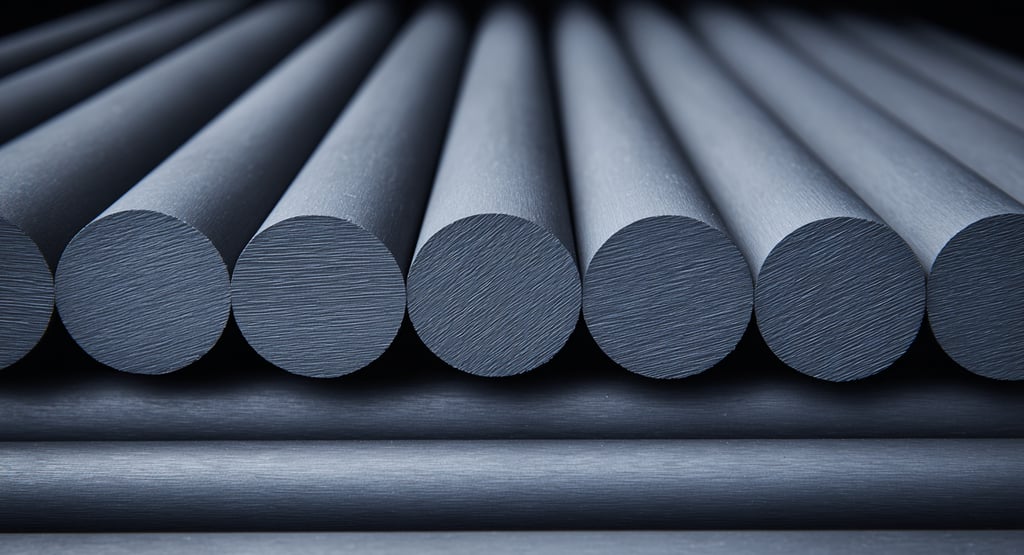
Polyvinyl Chloride, universally known as PVC, is one of the most widely produced and extensively used engineering plastics in the world. First developed in the 1920s and commercialised through the mid-20th century, PVC has become a cornerstone material across construction, chemical processing, electrical, and general industrial applications — valued for its excellent chemical resistance, inherent flame retardancy, dimensional stability, and remarkably accessible cost.
PVC is available in two primary forms — Rigid PVC (PVC-U) and Flexible PVC (PVC-P) — each serving fundamentally different application requirements. In engineering and industrial contexts, Rigid PVC is the most commonly specified form, offering a practical and cost-effective structural material for chemical handling, piping systems, ducting, and general fabrication.
What sets PVC apart from many other engineering plastics is its exceptional versatility and ease of fabrication — it can be cut, drilled, machined, solvent bonded, and hot air welded with standard equipment, making it accessible to fabricators of all sizes. Combined with its broad chemical resistance and low cost, PVC remains one of the most practical and widely stocked engineering plastics across Malaysian industry — from small workshop fabricators to large-scale chemical processing plants.
Available Grades
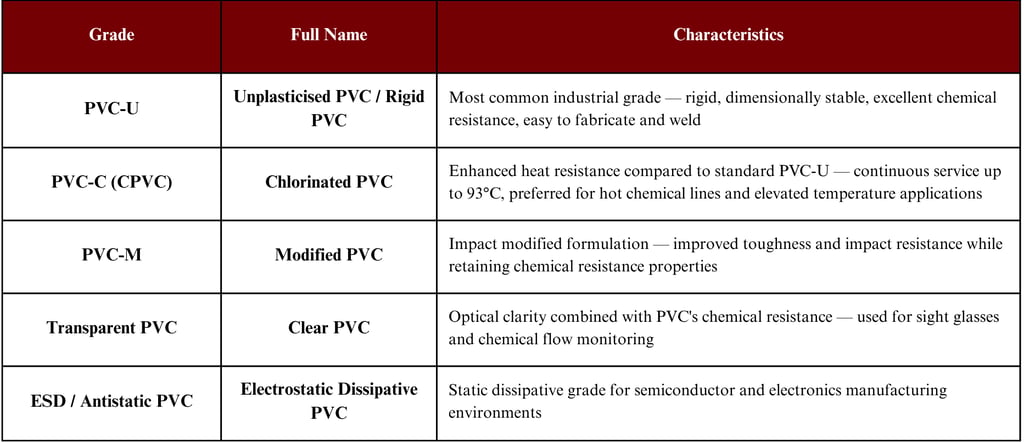
For general chemical handling, ducting, and fabrication applications, PVC-U is the standard specification. For hot chemical lines and elevated temperature environments, CPVC is the appropriate upgrade. For semiconductor and electronics factory applications, ESD grade PVC is increasingly specified across Johor's growing tech manufacturing sector.
Key Properties
Temperature Resistance
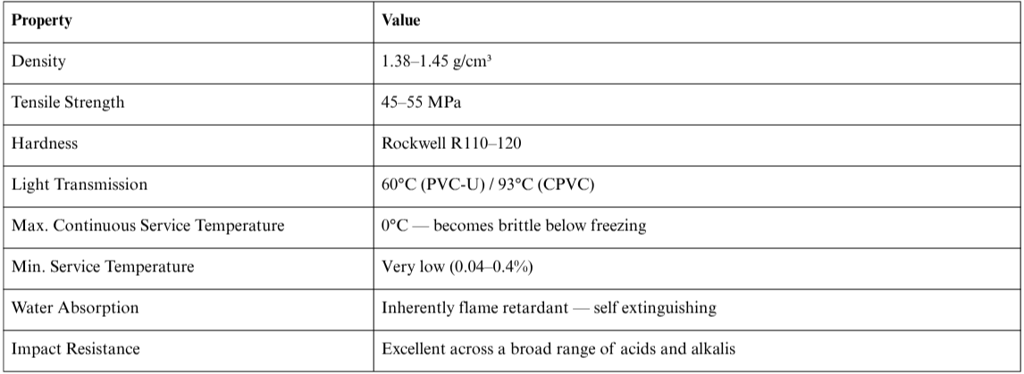
PVC offers reliable performance within a moderate temperature range, well suited to most ambient industrial environments in Malaysia.
Continuous service temperature: Up to 60°C (PVC-U) — sufficient for most ambient chemical handling and structural applications
Short term peak temperature: Up to 70°C
Low temperature performance: PVC becomes increasingly brittle below 0°C — not recommended for cold storage or cryogenic applications
Not recommended for: Hot chemical lines above 60°C — upgrade to CPVC for continuous service up to 93°C, or PP / PVDF for higher temperature and more aggressive chemical environments
Important note: PVC is one of the lower heat resistant engineering plastics — temperature limitations must be carefully considered in any application involving heated chemicals or elevated ambient temperatures
Chemical Resistance
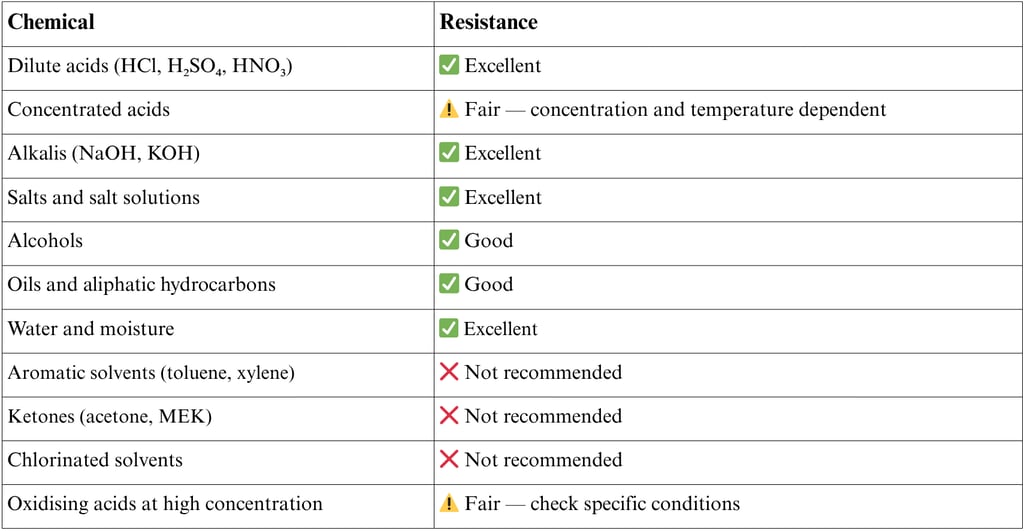
PVC offers broad and reliable chemical resistance across a wide range of commonly encountered industrial chemicals, making it one of the most practical and cost-effective chemical resistant materials available.
For applications involving aromatic or chlorinated solvents, PP or PVDF are the appropriate alternatives. For highly concentrated oxidising acids at elevated temperatures, PTFE is the recommended specification.
How PVC Compares to Similar Materials
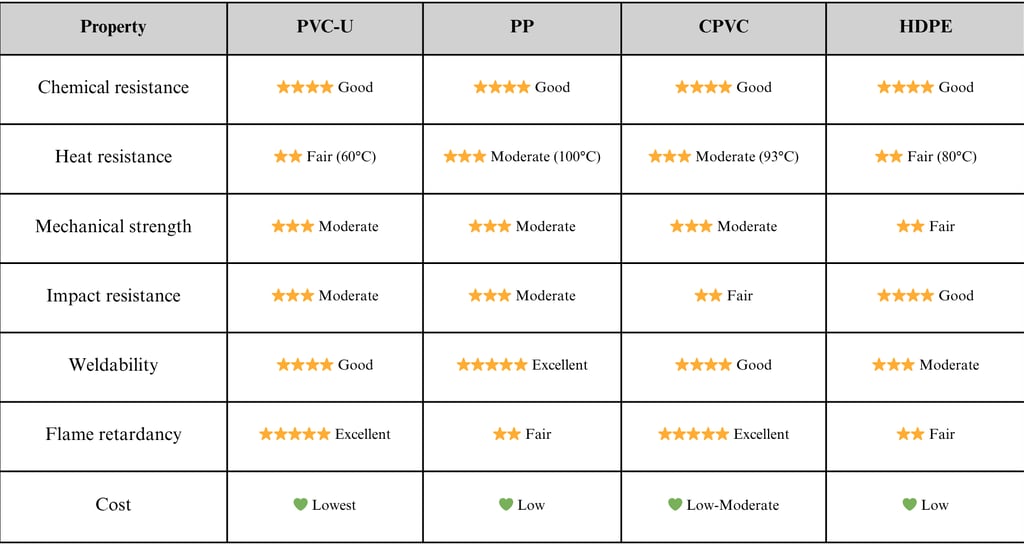
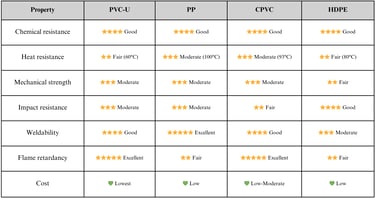
PVC vs PP — Both are cost-effective chemical resistant plastics widely used in Malaysian industry. PP outperforms PVC in heat resistance, chemical resistance against alkalis, and weldability for complex fabricated structures. PVC has the advantage of inherent flame retardancy and lower cost — making it the preferred choice for electrical conduit, general ducting, and applications where fire safety certification matters. For serious chemical handling above 60°C, PP is the natural upgrade from PVC.
PVC vs CPVC — CPVC is essentially an upgraded version of PVC with significantly higher heat resistance — extending continuous service from 60°C to 93°C. For hot chemical lines, heated process piping, and elevated temperature chemical handling, CPVC bridges the gap between standard PVC and the more expensive fluoropolymers. The cost difference between PVC and CPVC is modest, making CPVC an accessible upgrade wherever temperature is a concern.
PVC vs HDPE — Both are low cost, chemically resistant plastics for general industrial use. HDPE offers better impact resistance and performs better at low temperatures. PVC has superior flame retardancy and is easier to solvent bond. For chemical tanks requiring welded construction, both are viable — PP is generally preferred over either for serious chemical fabrication work.
Common Applications
PVC's combination of chemical resistance, flame retardancy, ease of fabrication, and low cost makes it one of the most universally applied engineering plastics across Malaysian construction, industrial, and chemical sectors:
Chemical processing — chemical storage tanks, acid containment trays, ducting and fume hoods, chemical resistant lining panels
Piping and fluid handling — industrial pipe systems, drainage piping, chemical transfer lines, irrigation systems
Electrical — cable conduit, cable trunking, electrical enclosure panels, wire management systems
Construction — window frames, door profiles, cladding panels, rainwater guttering and downpipes
Semiconductor and electronics — ESD grade PVC panels, chemical containment in wet process areas, antistatic work surfaces
Signage and display — foam PVC board for indoor signage, exhibition displays, point of sale boards
General fabrication — structural panels, protective liners, baffles, spacers, and general workshop components
Why Choose Us
We maintain consistent ready stock of PVC sheets and rods across a comprehensive range of sizes and colours, available for immediate dispatch from our Johor Bahru base with delivery. As one of the most widely used engineering plastics across Malaysian industry, PVC remains a core part of our product range. They are competitively priced, reliably stocked, and available in standard and speciality grades to suit every application requirement.
Whether you need standard grey PVC sheet for a chemical ducting project or ESD grade PVC for a semiconductor facility, we supply with fast turnaround and competitive pricing.
📲 Contact us for pricing, availability, and custom sizing.
Pom Metal & Plastic Engineering
Providing reliable industrial materials in Johor Bahru since 1994
Engineering
Service
pommetal@hotmail.com
+607-3535191
Copyright © 2025 Pom Metal & Plastic Engineering. No unauthorised reproduction without permission. All rights reserved.